Start With Bedtime, Not the Clock
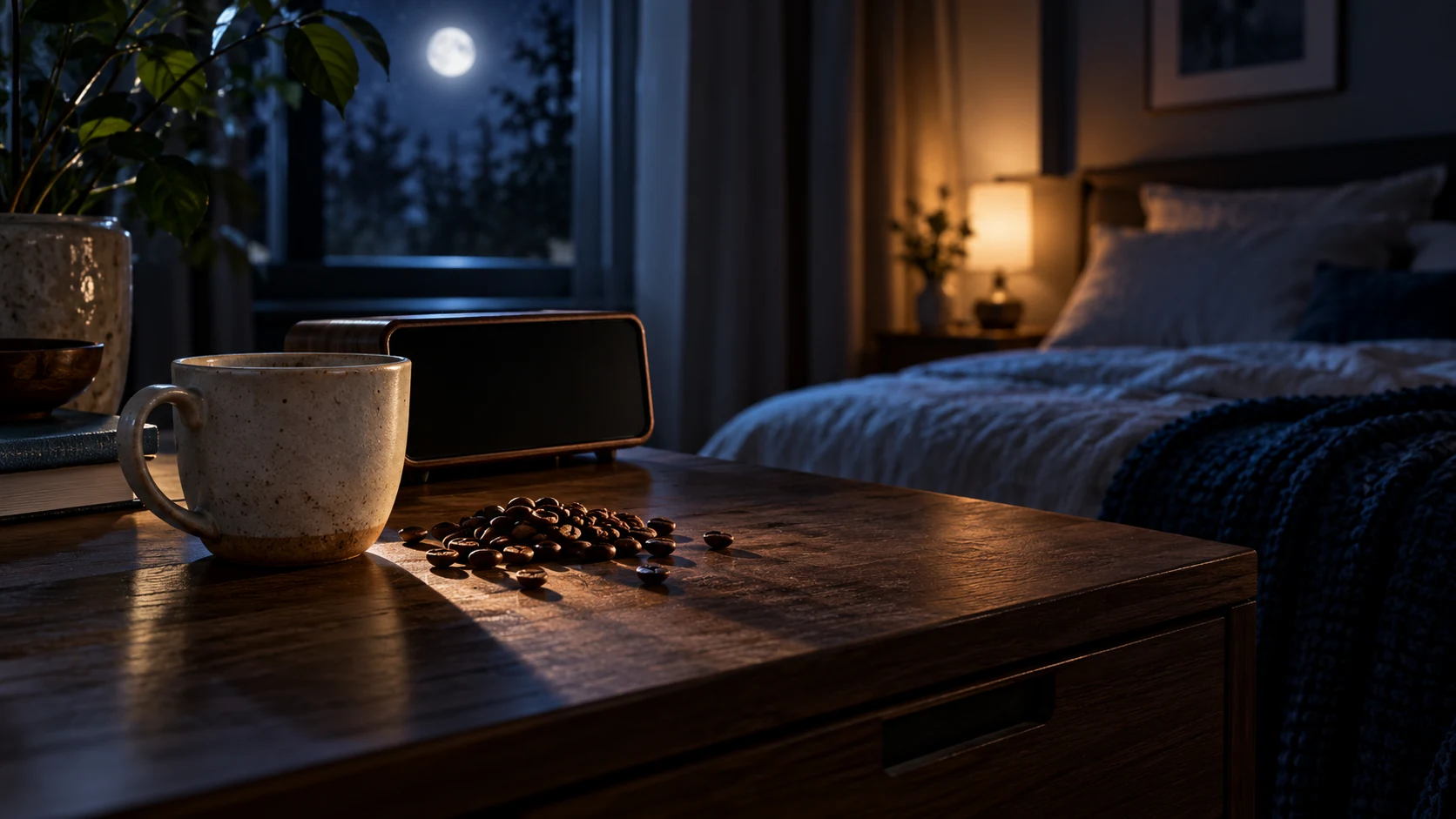
Work backward from the time you intend to sleep. A 100 to 200 milligram dose may still matter 8 to 10 hours later, although clearance varies from person to person. That makes a fixed rule such as “no caffeine after 2 p.m.” less useful than a cutoff tied to your own bedtime.
Falling asleep is not the only test. Residual caffeine can also reduce deep sleep and fragment REM sleep, leaving reaction time and consistency worse the next day. As a minimum safeguard, avoid stimulants in the final six hours before bed and move the cutoff earlier if sleep or morning alertness still suffers.
What Is Still in Your System at Lights Out
Systemic elimination rates dictate actual clearance. Subjective sensations of stimulation prove unreliable. Subjective alertness fades within 3 to 4 hours. Circulating concentrations dip below acute peak thresholds during this window. Active molecules remain heavily bound to central nervous system receptors for hours afterward. The perceived crash does not mean the drug has left your system. The receptor blockade continues interfering with sleep architecture long after you stop feeling energetic.
Half Life and Quarter Life Clearance Kinetics
The elimination half-life of caffeine averages 4 to 6 hours in healthy adults. The quarter-life extends between 8 and 12 hours. Drink a 200-milligram energy beverage at 6:00 PM. Approximately 100 milligrams remains circulating in blood plasma at 11:00 PM. Roughly 50 milligrams continues circulating at 4:00 AM. This mathematical reality ignores how tired you feel. The chemical half-life governs your sleep quality.
Low residual concentrations alter neurochemical signaling during rest. Amounts as small as 25 to 50 milligrams elevate nocturnal resting heart rate. Core body temperature increases. Physiological parasympathetic downshift encounters direct interference. Falling asleep requires a core temperature drop. Residual caffeine forces the body to work harder to achieve this thermal regulation.
Hepatic CYP1A2 Enzyme Metabolism
Hepatic clearance relies on the cytochrome P450 CYP1A2 enzyme. Genetic variability in the CYP1A2 gene creates substantial divergence. Slow-metabolizing polymorphisms trigger elimination half-lives exceeding 8 hours. High systemic concentrations remain long after consumption. If you are a slow metabolizer, a midday coffee ruins midnight sleep.
Rapid metabolizers clear caffeine within 3 to 4 hours. They remain vulnerable to sleep architecture disruptions. Large boluses exceeding 200 milligrams consumed within 5 hours of sleep onset will fragment their sleep cycles.
Adenosine Receptor Masking Mechanism
Adenosine acts as a somnogen. It accumulates during wakefulness to signal metabolic expenditure. It triggers restorative sleep. Caffeine occupies A1 and A2A adenosine receptors without initiating intracellular signaling. Somatic fatigue cues are temporarily muted. The brain is chemically blind to its own exhaustion.
Late-night caffeine masks the biological necessity for rest. The stimulant eventually clears during early morning hours. Unoccupied receptors become flooded by accumulated adenosine. Morning grogginess hits hard. Severe brain fog follows. Sleep feels entirely unrefreshing.
What Residual Caffeine Changes During the Night
Evening caffeine consumption compromises measurable sleep parameters across multiple stages. Controlled polysomnographic trials demonstrate these effects repeatedly.
| Timing Prior to Bedtime | Dose Consumed | Sleep Latency Increase | Total Sleep Time Reduction | Slow-Wave Sleep Impact |
|---|---|---|---|---|
| 0 Hours (At lights out) | 200 mg | +25 to 40 minutes | -60 to 90 minutes | Severe suppression (-30%) |
| 3 Hours prior | 200 mg | +18 to 30 minutes | -45 to 65 minutes | Moderate suppression (-20%) |
| 6 Hours prior | 200 mg | +10 to 18 minutes | -30 to 45 minutes | Measurable suppression (-12%) |
| 9 Hours prior | 200 mg | +0 to 5 minutes | -0 to 15 minutes | Negligible disruption |
Slow-wave sleep reduction represents the primary hazard. Stage-3 NREM sleep drives musculoskeletal recovery. Tissue regeneration depends on it. Growth hormone secretion peaks here. Metabolic clearance of cerebral metabolites requires stage-3. Suppressing slow-wave sleep impairs wrist tendon recovery. Spinal postural decompression suffers. Cognitive consolidation degrades. Carpal tunnel syndrome risks escalate when tissue repair windows are chemically truncated.
Why One Universal Cutoff Fails
Standard sleep hygiene guidelines advocate universal cutoffs. Ceasing caffeine intake at 2:00 PM is a common suggestion. This functional rule applies to individuals sleeping at 10:00 PM. It completely fails competitive gamers. Esports athletes run schedules extending far past midnight.

Establish your cutoff dynamically. Use a backward-calculation formula based on target lights-out time. Match your chemical intake to the actual match window.
| Target Sleep Time | Cutoff for 100 mg (8 hr window) | Cutoff for 200 mg (10 hr window) | Cutoff for 300 mg (12 hr window) |
|---|---|---|---|
| 11:00 PM | 3:00 PM | 1:00 PM | 11:00 AM |
| 1:00 AM | 5:00 PM | 3:00 PM | 1:00 PM |
| 3:00 AM | 7:00 PM | 5:00 PM | 3:00 PM |
| 5:00 AM (Late shift) | 9:00 PM | 7:00 PM | 5:00 PM |
Larger doses demand wider clearance windows. Consuming 300 milligrams at 7:00 PM before a 1:00 AM bedtime leaves over 100 milligrams active at lights-out. Sleep onset becomes severely disrupted. Nocturnal heart rate stability fails.
REM Fragmentation and Motor Skill Consolidation
Rapid eye movement sleep consolidates procedural memory. Sensorimotor adaptation relies on REM phases. Tactical pattern recognition solidifies here. Neural circuits activated during aim training undergo synaptic stabilization. Scrim tactics lock into memory during REM.
Circulating caffeine elevates nocturnal micro-arousals. REM cycles fragment into brief disrupted intervals. Degraded REM sleep ruins muscle memory retention from preceding practice sessions. Reaction adaptation to unfamiliar game updates slows down. Emotional volatility during competitive stress spikes significantly.
Late Tournament: Choose the Trade-Off
Esports schedules demand peak performance during evening championship brackets. These often start past 8:00 PM. High-stakes scenarios force a direct physiological trade-off. Immediate match alertness battles next-day recovery.
| Strategic Approach | Dosing Strategy | Performance Benefit | Sleep Cost Risk |
|---|---|---|---|
| Sublingual Low-Dose | 25–50 mg caffeine gum | Targeted alertness, rapid clearance | Low sleep disturbance |
| Standard Liquid Bolus | 150–200 mg energy drink | Sustained high vigilance | Substantial sleep fragmentation |
| Non-Stimulant Behavioral | Hydration, lighting, cold air | Mild alertness boost | Zero sleep architecture cost |
Mandatory evening stimulation requires specific tactics. Prefer low-dose sublingual options. Consume 25 to 50 milligrams via chewing gum 15 minutes before the match. Sublingual administration provides immediate buccal absorption. The total systemic burden stays small. Clearance happens hours faster than a heavy 200-milligram liquid dose.
Find Your Own Cutoff Over One Week
Individual clearance rates vary widely. Execute this 7-step process to identify your own cutoff. Keep the other variables as consistent as possible while you test it.
Fix the Target Bedtime
Set a consistent bedtime across a consecutive 7-day period. Consistent sleep timing isolates stimulant kinetics from circadian rhythm shifts.
Count Every Source
Track all sources of caffeine consumed throughout the day. Sodas count. Coffee and tea count. Include chocolates and pre-workout formulas.
Record the Last Dose
Record the exact minute you finish your last caffeinated item. Note the delivery format. Differentiate between liquid, pill, or gum.
Note How Long Sleep Takes
Note how long it takes to achieve unconsciousness after lying down. Latency exceeding 30 minutes indicates excessive residual arousal.
Check the Next Morning
Score your morning mental clarity. Evaluate physical eye dryness. Lingering morning brain fog points directly to suppressed stage-3 slow-wave sleep.
Move the Cutoff Earlier
Prolonged sleep latency requires adjustment. Poor morning recovery demands action. Move your final intake 60 minutes earlier for the next three days.
Separate Caffeine From Screen Arousal
Conclude gaming 45 minutes prior to sleep. Dim ambient lighting. Prevent blue-spectrum melatonin suppression from confounding your stimulant evaluation.
When This Experiment Is a Bad Idea
Using caffeine to counteract severe cumulative sleep debt creates an escalating physiological deficit. Sleeping less than 6 hours per night for multiple consecutive days triggers this trap. Stimulants mask perceptual tiredness. Microsleep vulnerability deteriorates anyway. Cognitive processing speed drops. Emotional tilt control fails entirely.
Persistent insomnia demands intervention. Resting cardiac palpitations signal overload. Night sweats require immediate cessation of afternoon and evening caffeine. Stimulant-induced sleep disruption compromises long-term ne.